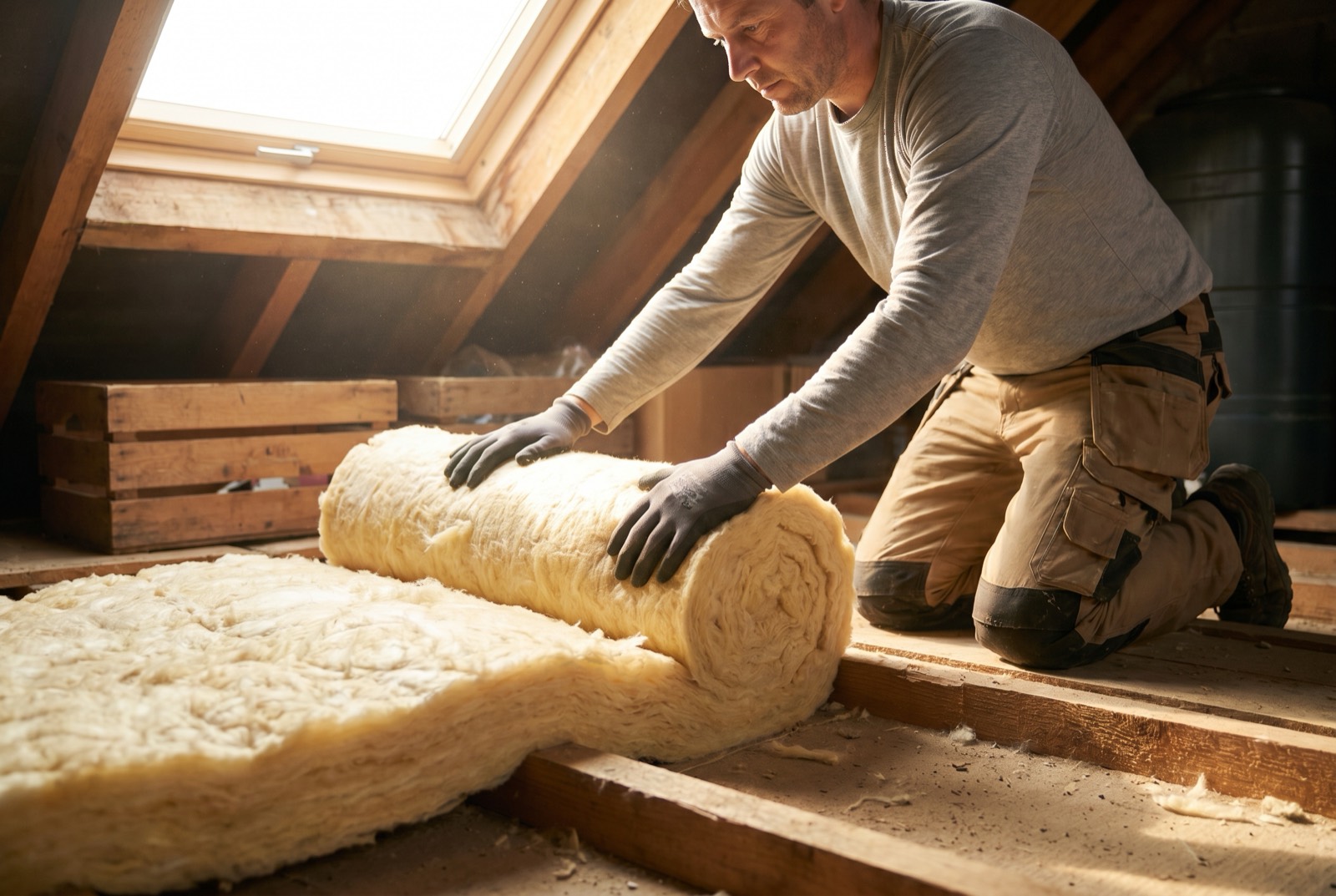
Insulating a home in Quebec is not a comfort detail: it is the first decision that determines how much you will pay to heat your house over the next twenty winters. Before buying a heat pump or replacing a heating system, you need to make sure heat isn't escaping through the building envelope. This guide explains where to start, what R-values to target depending on the zone of the house, how to measure air-tightness, and which financial incentives (notably the Rénoclimat program) can reimburse part of the work.
Why insulate the envelope before investing in heating
Hydro-Québec puts a clear number on how a home loses heat: about 75% escapes through the thermal envelope (roofs, walls, floors, windows) and the remaining 25% through air infiltration and ventilation. In other words, three quarters of your heating bill depend directly on the state of your envelope. The official recommendation is unambiguous: you should minimize losses through the envelope and air infiltration before investing in a heating system.
Hydro-Québec's LogisVert program sums up this principle in a simple formula: insulation first, heating second. A high-performance heat pump is useless if heat is escaping through the walls. This logic has a concrete impact on sizing: a well-insulated home needs a smaller heating unit, which is therefore cheaper to buy and to run. Taking advantage of a major renovation to improve insulation is thus the best time to act.
Which zones of the house should you insulate first
Not all surfaces are equal. Since heat rises, the attic (the space above the ceiling) is almost always the most cost-effective measure. Next come the above-grade walls, the foundation walls in the basement, and then critical zones that are often overlooked, such as the rim joists (the junction between the floor and the foundation), a major source of air infiltration. Windows and doors round out the picture: you replace them with ENERGY STAR certified models when they reach the end of their service life.
- Attic / loft: the most cost-effective measure, because heat rises.
- Above-grade walls: large surface area, big impact on the bill.
- Foundation walls and basement: significant losses in contact with the cold ground.
- Rim joists: a critical air-infiltration zone that is often forgotten.
- Windows and doors: to be replaced with ENERGY STAR certified models.
What R-value to target in Quebec under the Code and Novoclimat
The R-value (and its metric equivalent, the RSI) measures a material's resistance to heat flow: the higher it is, the better the surface insulates. The Quebec Construction Code (Part 11, energy efficiency, in force since 2012) distinguishes two climate zones: under 6,000 heating degree-days, and 6,000 degree-days or more (northern zones). Requirements rise in colder zones.
For the roof and attic, the Code calls for RSI 5.28 (R-30) under 6,000 degree-days and RSI 6.16 (R-35) at 6,000 degree-days or more. Several sources sum up the common practical requirement as R-41 (RSI 7.22) for cold-winter zones such as Montreal, Quebec City or Gatineau, and R-28 for flat or cathedral roofs. For above-grade walls, the Code requires RSI 3.81 (R-21.6) under 6,000 degree-days and RSI 4.40 (R-25) beyond that, with the practical value often cited being R-24.5 (RSI 4.31). For foundation walls and the basement, you target RSI 2.99 (R-17) under 6,000 degree-days and RSI 3.52 (R-20) in northern zones.
The Novoclimat program, which certifies new construction, sets more demanding reference targets that are easy to memorize: R-41 (RSI 7.21) for the roof and attic, R-24.5 (RSI 4.31) for above-grade walls and rim joists, R-17 (RSI 2.99) for foundation walls, and R-29.5 (RSI 5.2) for above-grade floors exposed to the cold. For the rim joist, the Code's reading gives a minimum of R-14 (RSI 2.46), but in practice you aim for R-24.5, the same level as above-grade walls. The exact R-values you need to reach in order to qualify for support, however, depend on the targets set out in your evaluation report and on the schedule in force.
Air-tightness: why the blower-door test is central
Insulating isn't enough if air circulates freely. Air-tightness is measured in air changes per hour (ACH) when the house is depressurized to 50 pascals, hence the ACH50 measurement. To give an order of magnitude, a typical new home from the 2000s was around 3.5 ACH50, whereas Novoclimat 2.0 requires a maximum of 1.5 ACH50, verified by a mandatory blower-door test under standard CAN/CGSB-149.10-M86. Écohabitation recommends aiming for under 3 ACH50 for good moisture management.
The detail that is often ignored: an air-tightness flaw can cause up to 95% of an air barrier's effectiveness to be lost if barely 1% of its surface is perforated. That shows how important it is to properly seal every joint. The blower-door test takes about 30 minutes and is part of a complete energy evaluation lasting 2 to 3 hours, carried out before and after the work under the Rénoclimat program.
How the Rénoclimat program works and what amounts to expect
Rénoclimat is the Government of Quebec program, administered by the Ministère de l'Environnement, de la Lutte contre les changements climatiques, de la Faune et des Parcs (MELCCFP), that supports insulation, air-tightness, doors and windows, and ventilation. The program has no planned end date and is still accepting new applications in 2025-2026. Important: since May 1, 2024, Rénoclimat no longer funds the installation of a heating system (heat pump, geothermal); that support has been redirected to Hydro-Québec's LogisVert, and in return the amounts for the envelope have been increased.
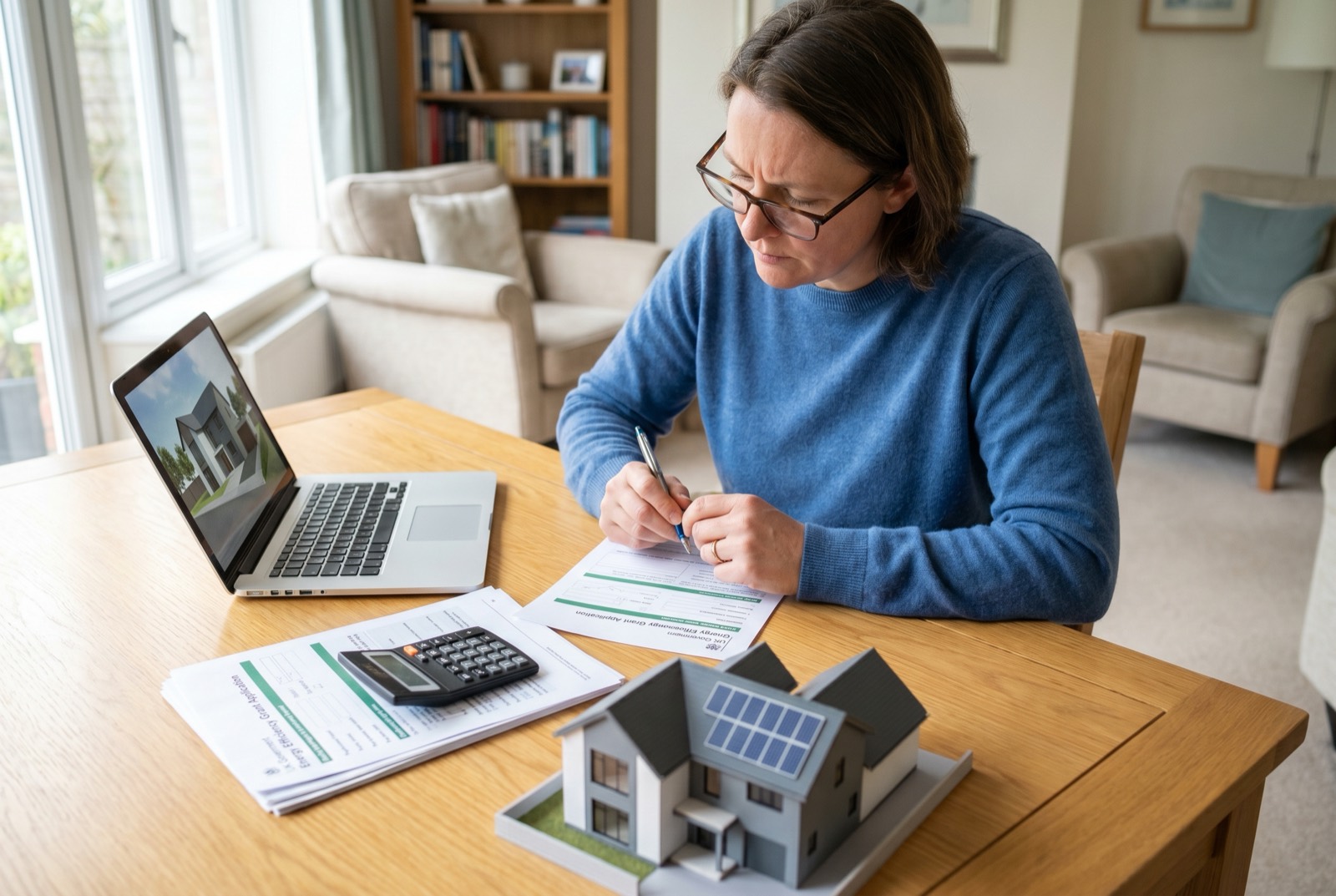
The process is precise: you register through the online form (in French), an advisor usually calls back within three weeks, then carries out a BEFORE-work energy evaluation with a blower-door test to establish the EnerGuide rating. Critical rule: any work started before this first evaluation is not eligible. After the recommended work, a second evaluation verifies that the EnerGuide rating has improved. Processing the file takes about 8 to 10 weeks, then count on roughly 2 weeks for the cheque to arrive by mail. The evaluation costs $150 plus taxes per visit, but that amount is reimbursed if eligible work is done, and the first evaluation after the work is free.
The amounts vary depending on the surface treated and the improvement achieved. For insulation, the schedule verified on quebec.ca provides $50 to $1,500 for the attic, $450 to $3,750 for above-grade exterior walls, $250 to $2,500 for foundation walls, $200 to $250 for rim joists (at least 80% of the surface to be insulated), $200 to $2,000 for a crawl-space wall, $500 for a floor above a crawl space, and $380 for an exposed floor. For air-tightness, support ranges from $400 (target met) to $600 (target exceeded by 10%) and $800 (target exceeded by 20%). Replacing ENERGY STAR certified doors and windows entitles you to $150 per opening, and a heat recovery ventilator (HRV) to $500.
- Attic / loft insulation: $50 to $1,500.
- Above-grade exterior walls: $450 to $3,750.
- Foundation walls / basement: $250 to $2,500.
- Air-tightness: $400 to $800 depending on the target reached.
- ENERGY STAR doors and windows: $150 per opening.
- Heat recovery ventilator (HRV): $500.
To be eligible on the residential side, the building must be a single-family home, a duplex, a triplex or a small multi-unit building (maximum 3 storeys above grade, ground-floor area of 600 m² or less), located in Quebec, habitable year-round, and built and occupied for at least 12 months. You must insulate at least 20% of the component's surface for the roof, exterior walls and foundation walls, at least 80% for rim joists, and 100% for an exposed floor (minimum 14 m²). Rénoclimat can also be combined with LogisVert and certain federal incentives, with the exact total depending on each project.
How much insulation costs and what the return on investment is
The cost of insulating a home depends on the area treated, the technique and the condition of the existing structure, so every project is quoted individually. Attic insulation is the most cost-effective measure per dollar spent, which is why it's usually tackled first. The material matters too: blown cellulose is among the cheapest options, while sprayed polyurethane is more expensive but seals and insulates in one pass — a common combined approach is about 2 inches of urethane topped with blown cellulose or wool. Basement insulation tends to cost more when the foundation needs prep. For an accurate figure for your home, get a written quote based on an on-site assessment rather than a per-square-foot rule of thumb.
The principle of diminishing returns, illustrated by Écohabitation, is worth understanding: adding an inch of insulation to a wall that has only one is always worthwhile, but adding an inch to a wall that already has 30 makes no sense anywhere. That is why you start with under-insulated zones. The logic of payback is simple: an insulation measure that meaningfully cuts your annual heating bill recovers its cost over a handful of years, then keeps producing savings for the rest of the building's life. The shorter the payback, the more worthwhile the measure — and the best returns almost always come from the most under-insulated parts of the home.
Common mistakes: thermal bridges and vapour barriers
Two concepts are often confused: the vapour barrier prevents the diffusion of water vapour from the inside toward the outside, whereas the air barrier blocks air infiltration. The same polyethylene film can play both roles, provided it is perfectly sealed at every joint. In a cold climate, the one-third / two-thirds rule (Écohabitation) consists of placing about two thirds of the insulation on the cold side (exterior) and one third on the warm side (interior), with the vapour barrier located in the inner third, between the insulation and the finish.
- Double vapour barrier: traps moisture in the wall if the air-tightness is imperfect.
- Vapour barrier installed on the exterior side over a wood frame: blocks drying in a cold climate.
- Discontinuity in the air barrier: cancels out a large part of its effectiveness.
- Tyvek-type membranes exposed to UV: they degrade in 4 to 9 months if left unprotected.
- Neglected rim joist: a major thermal bridge at the floor / foundation junction, often treated with sprayed polyurethane foam.
- Stone walls: do not install a vapour barrier, as they need to breathe.
Attic ventilation is just as important: provide a free ventilation area of at least 1/300 of the insulated ceiling area (or 1/150 for a low-slope roof), never block the soffit air intakes, and install baffles between the rafters to maintain a clearance between the insulation and the roof sheathing. A well-insulated but poorly ventilated attic can accumulate moisture and damage the structure.
A high-performance heat pump is useless if heat is escaping through the walls.
LogisVert principle, Hydro-Québec
Frequently asked questions
Where should I start if my budget is limited? With the attic. It's the most cost-effective measure, because heat rises, and its cost stays modest compared with its impact on the bill. You then tackle under-insulated zones such as the rim joists and the basement. A quote from an RBQ-licensed contractor will tell you what each measure costs for your home.
Can I start the work before the Rénoclimat evaluation? No. This is the program's critical rule: any work started or completed before the first energy evaluation is not eligible. You must register your project and have the evaluation done BEFORE installing any insulation.
Does Rénoclimat still cover heat pumps? No, not since May 1, 2024. Support for heating systems (heat pump, geothermal) has been redirected to Hydro-Québec's LogisVert program. Rénoclimat now focuses on insulation, air-tightness, doors and windows, and ventilation.
Is the energy evaluation really reimbursed? Yes, under one condition. You pay $150 plus taxes per visit, but that amount is reimbursed when the support is paid out if eligible subsidized work is carried out, and the first evaluation after the work is free.
Amounts, R-values and conditions change regularly. Before committing to any work, always confirm the schedules in force with the official sources: Hydro-Québec for LogisVert, Transition énergétique Québec and quebec.ca for Rénoclimat, and the Régie du bâtiment du Québec (RBQ) to make sure your contractor holds a valid licence. The precise insulation targets for your home will appear in your Rénoclimat evaluation report and in the participant guide in force.
Related on Québec Rénovation